Greta Gerwig is Uncle Andrew
A simile is a comparison using “like” or “as.” The Bible uses a simile to compare God with a bridegroom in Isaiah 62:5, “and as a groom rejoices over his bride, so your God will rejoice over you.”
A metaphor is a comparison without the use of “like” or “as,” but stated as a direct correspondence. Mirriam-Webster defines metaphor as a figure of speech in which a word or phrase literally denoting one kind of object or idea is used in place of another to suggest a likeness or analogy between them.[1]
There are plenty of metaphors in the Bible for God. Moses declares, “He is the Rock, His work is perfect; all His ways are just” (Deuteronomy 32:4). Isaiah employs metaphor to describe God as a potter, “But now, O LORD, You are our Father; we are the clay, and You are our potter; we all are the work of Your hand” (Isaiah 64:8). David poetically compares God to a fortress, “The LORD is my rock, my fortress, and my deliverer” (Psalm 18:2). Perhaps the most famous metaphor in Scripture is when David began the 23rd Psalm, “The Lord is my Shepherd…” God is compared to a shepherd, which extends the metaphor to us being compared to sheep. Psalm 23:1 is the most commonly highlighted Bible verse in the You Version App. Jesus certainly had read Psalm 23 and had no hesitation calling Himself the Good Shepherd (John 10:11,14).
When is a Metaphor Not a Metaphor?
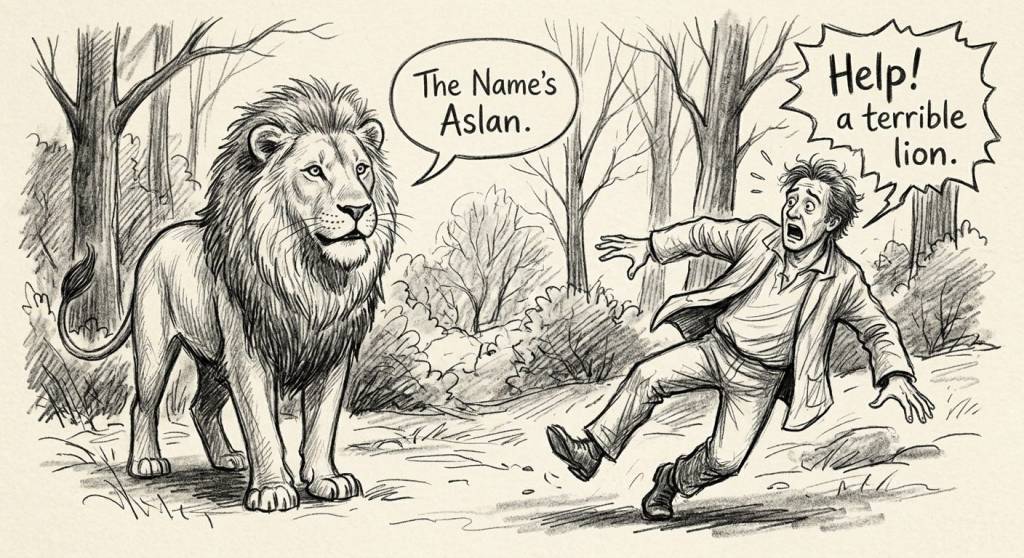
A sentence with two nouns using the form of the verb “to be” is not necessarily a metaphor. Another option is that one noun is the subject and the second is a predicate nominative. My favorite way to remember this is the way the super-spy introduces himself, “The name’s Bond, James Bond.” This is not a metaphor because it is an expression of reality, not comparison. If a sentence contains a metaphor, it can be restated as a simile through the use of “like” or “as.” The secret agent would not say, “The name is like Bond.”
I contend that some Biblical models that are taken as metaphor should rather be understood as predicate nominatives. Such is the case for considering God to be Father. He is not like a father; He is Father. When Jesus gave us instructions to pray, “Our Father in heaven, hallowed be Your name” (Matthew 6:9), He did not intend the meaning “Dear God, who is like a Father…” He is depicting reality. At the baptism of Jesus, God did not voice from heaven, “This non-binary soul is like my son or daughter.” God proclaimed that Jesus is the Son. It is also not a metaphor to say that God is King. “For God is King of all the earth; sing profound praises to Him” (Psalm 47:7). God does not remind us of a king – He is King!
In the newest Narnia film, director Greta Gerwig has cast Meryl Streep as the voice of Aslan. Some do not see a problem with this because they consider Aslan to be a metaphor of Jesus. In this case, the comparison can still hold true no matter the voice or artistry. In the same vein, the rendition of Aslan in Gerwig’s film is reminiscent of David Bowie’s bisexual character with two different-colored eyes.
Why then is anyone concerned? The answer is that Aslan is not a metaphor for Jesus. Aslan is Jesus. By his own self-revelation at the end of The Voyage of the Dawn Treader, Aslan comforts Lucy saying that she and the children must learn to know him by his name in our world. Yes, the books are fantasy. Lewis did not intend them to be allegory. The point is that Aslan in Narnia does not merely remind us of Jesus – he is Jesus. Jesus is God, the Son. Any depiction of Jesus making Him appear female or even feminine in any way is an assault on the very Person of God.
When is a Christian not a Christian?
Greta Gerwig was raised as a Unitarian Universalist. In the film Frances Ha, which she co-wrote and starred in, she depicted the Unitarian Universalist church in which she was raised. She said in an interview, “I think religion has always been something that has occupied me as a person, and Unitarianism is the most complete expression of my multiple and, at times, contradictory thoughts about the spiritual life. I think the openness of the community allows for a greater variety of personal faith and ideas.”[2]The Unitarian Universalist religion has an unorthodox regard for Jesus. Despite a later perusal of religion through a Catholic school, protestant church services, and Quaker gatherings, it is clear that she has never adopted the view of Jesus as revealed in Scripture. In short, she does not know Jesus. That is why her imagination of Aslan is only as a musical lion who sang the world into being. The Unitarian Universalist religion is not a Christian denomination.
In the novel, The Magician’s Nephew, Digory Kirke’s uncle Andrew follows him into Narnia but his closed-mindedness will not allow him to appreciate the world’s wonder. When Aslan speaks to him. Uncle Andrew only hears a lion roaring. His character is a sad foil to the children Digory and Polly who grow to love Aslan. Gerwig read the books and studied the life and writings of Lewis. She claimed to have read what Lewis wrote and what he read. One wonders if that includes the Bible, which Lewis certainly read. She read about Aslan, but since she doesn’t know Jesus, she doesn’t know Aslan. She only sees a lion. Here is a metaphor about the movie – Greta Gerwig is Uncle Andrew.
By the way, I will be taking these opinions to anyone who will listen and to the realm of social media. If not for expressing opinions like this, what is Meta for? See what I did there?
[1] https://www.merriam-webster.com/dictionary/metaphor. accessed 10.20.26.
[2] Cynthia Littleton, “Greta Gerwig, UU Film Star,” UU World, Fall 2013, 52. https://www.uuworld.org/articles/gerwig-uu-film-star, accessed 10.16.26.

